
01
Two generations of the same idea
Both cars run a four litre V8 with two turbochargers, and the newer of the two carries the later development of that engine. What changes between them is not the concept but the software, the hardware around it and the way the car puts its output onto the road.
That matters for calibration, because a file built for a C7 has no business being dropped into a C8. The engine management on the newer car watches more, corrects faster and expects its instructions to arrive in a different shape. Anyone offering to flash the same file into both has not looked at the car.
Which generation sits on your drive, and whether it is the performance version, is settled at the start. The registration and the vehicle itself answer that in a minute, and it saves guessing later.
02
The order things get checked in
Oil comes first on a car like this, and not as a formality. A V8 with two turbochargers hanging off it works its oil hard, and old oil that has been through too many short trips tells you plenty about how the engine has been treated. Level, colour and service history all get a look.
Then the turbochargers themselves. Shaft play, oil weeping past the seals, a wastegate that rattles or an actuator that has lost its edge are all reasons to stop and have a conversation. A calibration asking more of a tired pair of turbos is the wrong answer to any question.
Fault memory across the modules follows, along with live data while the engine runs. Our page on diagnostic health checks explains what that covers in more detail.
03
Cooling, charge air and a hot afternoon
Kent in August is not the environment Audi had in mind when the cooling pack was signed off, and a queue on the M2 with the air conditioning working is a genuine test. Coolant level and condition are checked, and so is the state of the radiator and charge cooler faces, because a pack half blocked with road debris and insects will struggle long before the gauge admits it.
Charge air is the other half of the story. Pipe joints, clips and the cooler core are examined for leaks and for the sort of slow deterioration that never throws a code but quietly costs performance. A boost leak on a car like this is felt as flatness rather than as a fault.
None of this is a prediction of failure. It is simply the ground a file has to stand on.
04
What a tune does to a turbo V8
The engine is not short of ability. What owners notice after calibration is the shape of the delivery: the way the car picks up from a steady cruise without dropping two gears, the way a part throttle overtake becomes a single clean movement rather than a pause and a lunge.
That comes from adjusting air charge, fuelling, ignition and the torque limiters together, and from leaving the protection strategies doing their job. On a car with this much torque, the limiters in the lower gears are doing useful work, and a file that simply removes them buys nothing except a set of expensive noises.
The car has an automatic gearbox, and how it behaves after the engine work depends on which unit is fitted and how it has been looked after. Where the shifts feel behind the engine, that is a separate conversation, covered on our gearbox tuning page. Owners weighing up sharper response against a calmer cruise should read power versus economy before deciding.
If an RS7 arrives already carrying a map from elsewhere, that file gets read first, and a poor one is a reason to begin again from a known base rather than to build on top of it.
05
Where the work is done
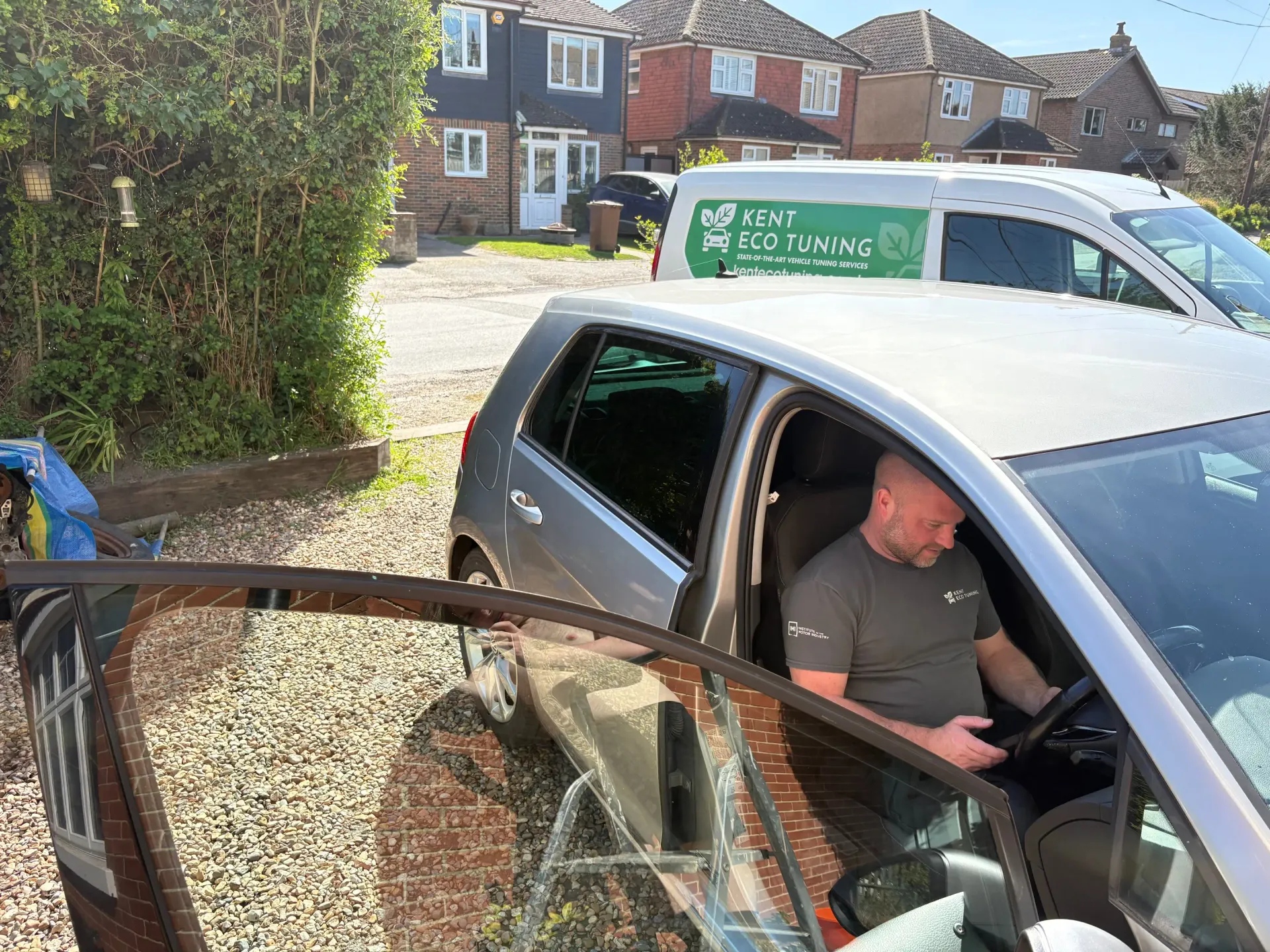
The car stays where it is parked. There is no workshop to bring it to and nothing to drop off, because the service travels to the customer. That suits a car like this, which many owners would rather not hand to a stranger with a van and a ramp.
Reading the original software takes a while on this engine management. The file is then prepared around your answers about how the car is used, written back once the inspection has cleared, and followed by a road test and a second look at live data.
06
Arranging a look at your car
Phone 07946 854971 and we can talk the car through properly, or use the contact form to send the registration along with a note on your driving. Questions about the wider range are gathered at Audi remapping Kent, and the smaller RS cars are covered at Audi RS3 remapping. Anyone uneasy about what calibration does to a modern engine should read our explainer on safety first.
07
RS7 tuning questions
08
Is the performance version treated differently?
It starts from a stronger base, so the priorities shift towards protecting what is already there. Hardware condition decides how much room a file has, and that is judged from the car rather than from the badge.
09
Can the car be tuned if it already has a map?
Yes, once that file has been read and assessed. Starting again from a clean base is often the better route.
10
Does a tune change the exhaust note?
No. Sound is a matter of pipework and silencers, not of software.
11
Will it still be usable in traffic?
That is usually the point. Most of the improvement is felt at low speed, where the standard car feels heavier than it needs to.