
01
What these cars are asked to do
A standard CLA is a compact four door with a coupe roofline, and it is usually the family workhorse rather than the weekend toy. That means it lives in traffic, on the M20, and on the school run, and it rarely gets to stretch.
Two engines sit under this heading. The M270 is the four cylinder that carried the earlier C117 cars, and the M282 is the smaller 1.3 that arrived with the C118 generation. Both are turbocharged, both are modest in capacity, and both leave the factory with a file written for the widest possible set of owners.
That last point is what a calibration works with. The manufacturer cannot know whether the car will spend its life at a steady motorway cruise or crawling through Chatham at eight in the morning, so the standard file is cautious everywhere.
The result is a car that feels heavier than it is at low speed and vague about what the pedal is asking for. Owners often assume that is just how the model drives. Often it is not.
02
The M270 and the M282
The M270 is a four cylinder turbo that has been around long enough to have a well understood set of behaviours. It is smooth enough, and it responds well to a file that brings the torque in a little earlier and holds it longer through the middle of the range.
The M282 is the 1.3, and it is a different proposition. It is a small engine in a car of reasonable size, and expectations should stay realistic. A tune makes the car easier to drive, more willing to pull away and less likely to need a downshift on a gentle incline. It does not turn it into a performance car, and pretending otherwise would be dishonest.
Where the two overlap is in the everyday experience. Both benefit from better pedal response, tidier gearshifts on the automatic versions, and a power delivery that matches how the car is actually used.
Engines and gearboxes varied across the two generations and across the range, so the exact combination on your car is confirmed from the registration before anything is planned.
03
What the check covers
The inspection on a CLA is straightforward because the cars are straightforward, but it is no less thorough for that.
Fault memory is read across every module. Live data is captured on a drive, which tells us how the engine is breathing and whether the boost control is behaving. Intake and charge pipe condition is inspected for splits and for the leaks that develop quietly around the joints.
Service history is worth having to hand, and fluid condition is checked. A car that has missed its oil changes does not improve with software, and a neglected one rarely rewards a calibration.
The gearbox gets a look as well. On a car used mostly in traffic, the way the transmission behaves matters as much as the engine, and an automatic that is already hesitant will not be cured by an engine file.
04
The day, from arrival to road test
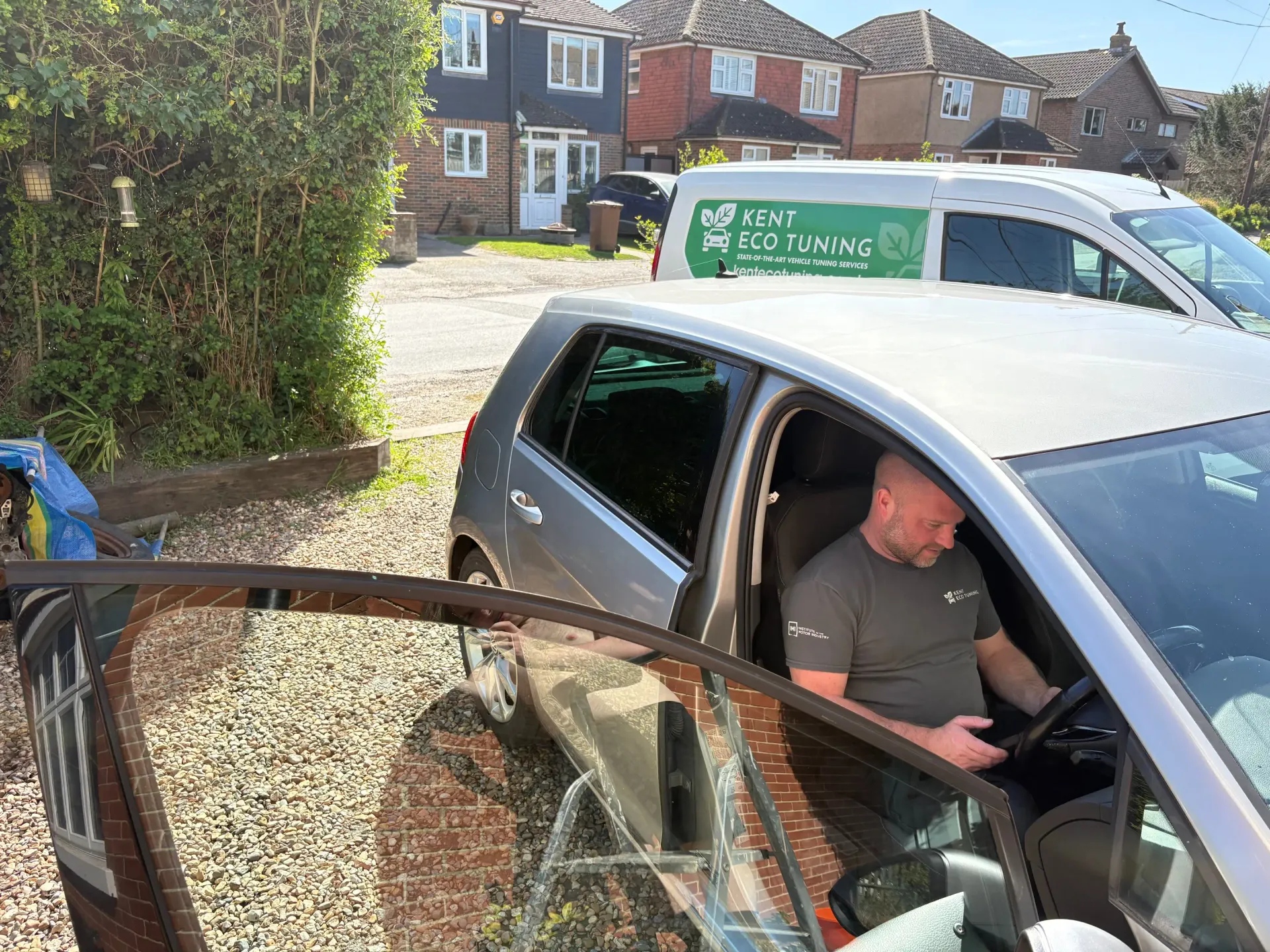
The car does not move. Everything happens at the address you give, because the service is mobile and there is nowhere to drop a car off. Before the laptop comes out, a dealer-level diagnostic health check gets done.
The first part is a conversation. Weekly mileage, the sort of roads, whether the car is ever fully loaded, whether it tows a small trailer, and what you would like to be different. Those answers decide the shape of the file.
The original software is read and saved, and the calibration is written once the check has cleared. A road test follows, with live data logged so the before and after can be compared properly.
Any automatic transmission is checked for how it behaves under load both before and after. On a car used mostly in traffic, that is where owners notice the most change.
05
Choosing a direction
Power and economy are the two usual requests, and on a CLA they are closer together than you might think. Most owners want the car to feel more responsive rather than faster, and that is a power file softened at the top.
Economy suits the high mileage driver, the one doing a motorway run for work, and it is written for steady running rather than outright response. Towing torque is the third option, useful for anyone who puts a small trailer or a bike rack on the back.
The differences are spelled out on the power versus economy page. Owners of automatic cars who find the shifts hesitant may want to read about gearbox tuning, which is a separate job.
06
Is it worth it on a standard CLA
For most owners, yes, provided the car is healthy and the expectations are sane. The improvement is in the way the car behaves in ordinary conditions rather than in any single impressive moment.
For a car with a slipping boost hose, a worn turbo or a loaded filter, the answer is to sort those first. That is not a sales tactic. It is what the inspection is for, and it is why a car gets looked at before it gets written to.
Insurance should be told about any change. The technician is IMI certified and the work is carried out under full insurance.
07
Get in touch
Ring 07946 854971 with the registration ready, or use the contact form and describe the car and your week. The range is summarised at Mercedes remapping Kent, the hatchback and coupe models at A Class tuning, and the towns served at areas covered.
08
CLA tuning questions
09
Will the 1.3 feel much different?
It will feel easier and more willing. It will not become quick, because it is a small engine, and the file is written with that in mind.
10
Can the automatic gearbox be improved?
It gets considered as its own job. On a car used in traffic, that can be as noticeable as the engine side.
11
Is an automatic CLA worth tuning?
Yes, on a healthy example. The inspection covers the engine and the transmission, and anything found is put right before a file is written.
12
Can I keep the standard map as a fallback?
You can. The original file is saved before anything is changed, so returning the car to standard is always possible.
13
Related models
Owners often compare this with Mercedes-Benz A35, Mercedes-Benz A45 and Mercedes-AMG GT, and each has its own page covering the engines and what the calibration changes.