
01
Why a car like this answers a calibration so well
Every car leaves the factory with software that has to cope with poor fuel, high altitude, indifferent servicing and drivers who never lift the bonnet. That spread of conditions forces the manufacturer to leave room in the file, and the middle of the rev range is where most of that room sits.
A calibration written for one healthy car and one real driver can use that space. On an A45 the difference shows up in how the car gathers itself out of a bend, and in the small delay between asking for a gap in traffic and getting it.
Owners describe the standard car as restrained until it is working. A careful file joins the earlier part of the range to the rest. Related models often cross-shopped include Mercedes-Benz C43, Mercedes-Benz Citan and Mercedes-Benz CLA 45, each covered on its own page. Related models often cross-shopped include Mercedes-Benz CLA, Mercedes-Benz E CLAss and Mercedes-Benz E63, each covered on its own page. Related models often cross-shopped include Mercedes-Benz GLA 45, Mercedes-Benz GLA and Mercedes-Benz GLB, each covered on its own page. Related models often cross-shopped include Mercedes-Benz GLC, Mercedes-Benz GLE and Mercedes-Benz S CLAss, each covered on its own page. Related models often cross-shopped include Mercedes-Benz V CLAss and Mercedes-Benz Vito, each covered on its own page.
02
The M133, the M139 and what sits between them
The M133 in the W176 is the engine that gave the model its reputation. It is vocal, willing and quick to build boost, which means it rewards a file that understands how fast the turbo comes in and does not fight it.
The M139 in the W177 is a different sort of engine. It runs high boost from the factory, so it has less headroom and it asks more of everything bolted to it. The A45 S version of that engine is the most highly strung and gets treated accordingly.
If your car was offered with a choice of transmission, the version actually fitted changes how the work is approached. Rather than guess, the registration is checked and the car confirmed before anything is planned.
Drivers often ask whether the earlier car is the better candidate. It is not a question of better, only of different. An older M133 car with good history can take a lovely file, while a newer M139 needs its supporting hardware in order before it will thank you for one.
03
What gets checked before the file is written
A high boost four cylinder has more ways to be tired than an ordinary engine, and the inspection looks at all of them. Charge pipes are examined for splits and for the softening that comes before a split. The intercooler and its pipework are checked for leaks and for the state of the core.
Intake deposits matter on any direct injection engine, and on these cars they can dull the response long before a driver notices a fault code. The turbocharger itself gets proper attention, with a look at shaft play, oil seepage and the condition of the wastegate.
Then there is the question of what someone else has already done. AMG models are frequently mapped, and many run a tuning box the owner may not think of as a modification. Whatever map is already in there gets read and judged, and a box comes off, before new software goes in. Writing over an unknown map is how engines get damaged.
The rest of the check is routine but important. Coolant and oil condition, fault memory across every module, and live data logged on a drive so the numbers come from this car rather than from a book. Full detail of that process is on our page about diagnostic health checks.
04
The day itself
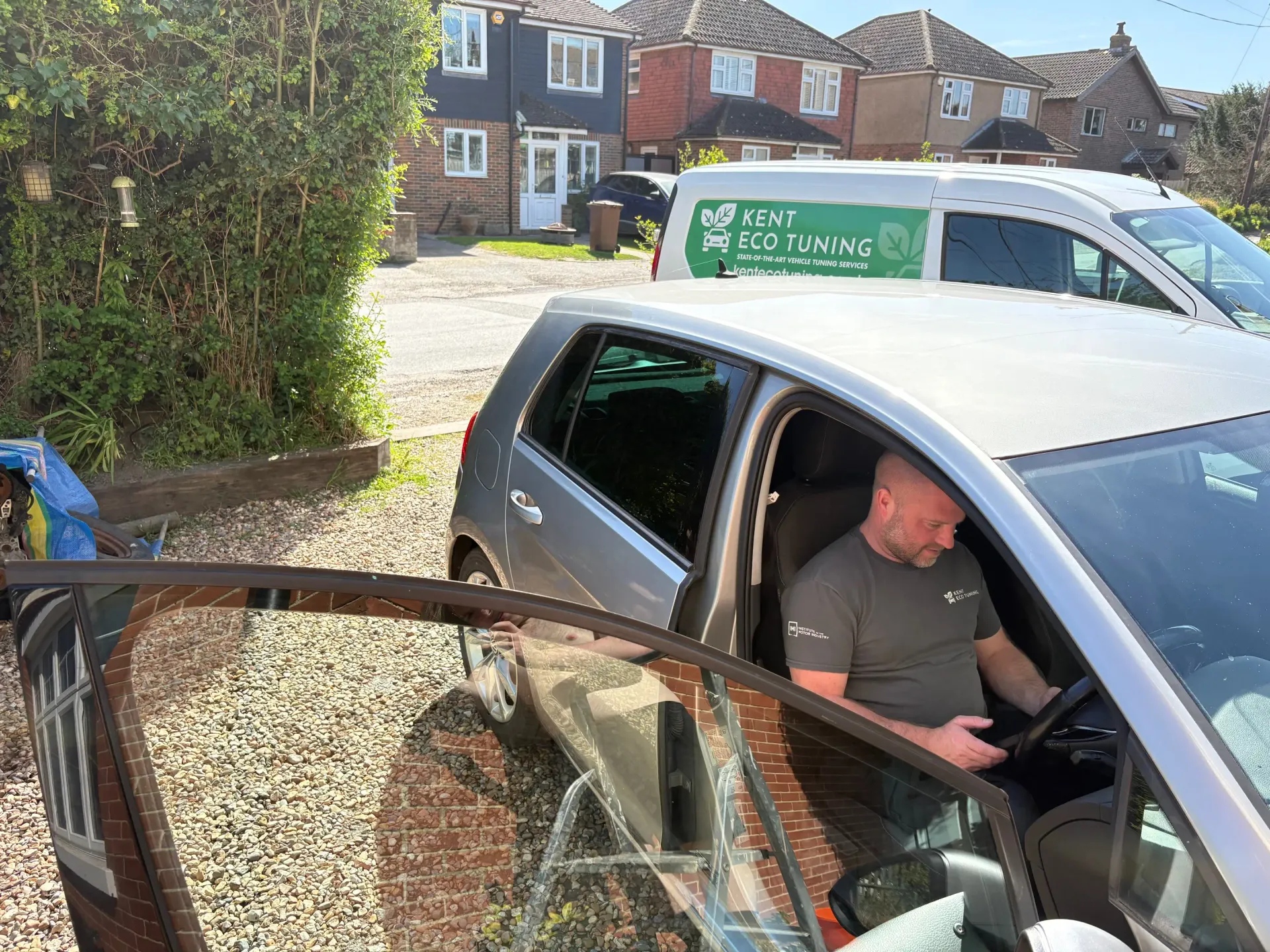
The service comes to you, which means no workshop booking and nothing to drop off. The car stays where it lives and the work is done around it.
It starts with questions. Weekly pattern, short runs or motorway miles, and what you want from the change. The answers decide the shape of the calibration more than the engine code does.
Fault codes are read from every module, live data is captured on the road, and the original software is saved. That last point matters, because it means the car can be returned to standard whenever you want.
The file is written, loaded, and the car goes back out for a second drive. Logs are compared against the first run, and anything that looks odd is investigated before the job is finished.
05
Power, economy or something in between
The work is not one fixed product. Some owners want the sharper end of what the car can do. Others use an A45 as a daily and would rather have a calmer motorway cruise and less thirst when they are behaving.
Both are reasonable, and the file reflects the choice. The differences are set out on our power versus economy page, and anyone with an automatic who wants cleaner shifts should look at the gearbox work offered separately.
A middle option exists too, and it is often the most popular one. Quick when asked and relaxed when not is what most owners want from a fast hatchback.
06
Is this the right move for your car
A healthy A45 with good history takes a calibration comfortably and feels quite different afterwards in ordinary use. A car with tired charge pipes, a weeping turbo and a mystery map from three owners ago is a different conversation entirely.
No car gets tuned here unless it is sound. If the check turns something up, the findings are explained in plain terms and the choice stays with you. Very often that means a repair first and software afterwards, which is the correct order of events.
Insurance is worth a mention at this point, because a modified car should be declared. The work is carried out by an IMI certified technician and the business carries full insurance.
07
Arranging a visit
Send the registration and a line about how the car is used. Ring 07946 854971, or use the contact form and the details come straight through. The wider range is gathered at Mercedes remapping Kent, and the smaller A Class models sit under A Class remapping.
08
A45 tuning questions
09
Does the A45 S need a different file from the A45?
Both are M139 cars, but the S leaves less margin for a careless calibration. It gets the same thorough inspection, and the file is written with its tighter limits in mind.
10
Can a tuning box be removed during the visit?
It can, and the wiring gets checked once it is off. What matters is that the car is running its own standard software before anything new is written.
11
Is a high mileage example still worth tuning?
Mileage by itself decides very little. Condition decides almost everything, and a well looked after car with plenty of miles behind it is often the better starting point.
12
What happens if the inspection finds a fault?
You get told what it is, what it means and roughly what it involves to put right. The tuning waits until the car is ready for it.
13
Related models
Owners often compare this with Mercedes-Benz A35, Mercedes-AMG GT and Mercedes-Benz B CLAss, and each has its own page covering the engines and what the calibration changes.