
01
Three diesels and a petrol, and two very different jobs
Most ASX models on UK roads are diesel, and three oil burners were offered over the car's life. The 1.8 came first and is the one that turns up most often on a commute. The 2.2 arrived later and suits a car that spends more of its life loaded or on a motorway. The 1.6 followed towards the end of the run, a smaller unit that is fine around town.
Then there is the 1.6 petrol, which is a naturally aspirated engine rather than a turbo. That distinction matters more than anything else on this page, because the two types of engine respond to tuning in completely different amounts.
Which of them you have, and whether the car left the factory with a manual or an automatic, is confirmed from the registration. There is no point assuming.
02
What a diesel ASX gains and why
A turbo diesel of this size is deliberately held back in standard form. The manufacturer builds in margin for poor fuel, for neglected servicing, for drivers who never let the engine warm through, and for a range of climates far wider than Kent's.
A calibration recovers some of that margin. The most noticeable effect in everyday driving is not at the top of the rev range but in the middle, where an ASX owner actually uses the car: joining the A2 from a slip road, overtaking a lorry on the A20, or pulling away from a roundabout with four people and a boot full of shopping.
The 2.2 has the most capacity to work with and takes the change most comfortably. The 1.8 responds well but with less room to move, and the 1.6 less again, because it is a smaller engine doing the same job.
03
The petrol car, stated honestly
The 1.6 petrol is not turbocharged, and it is worth being straightforward about what that means. There is no boost pressure to adjust, so there is no hidden reserve waiting to be released. What a calibration can do is refine how the engine responds to the pedal and how it delivers what it already has.
On a naturally aspirated engine the change is subtle. An owner who is expecting a transformation will be disappointed, and we would rather say that now than have that conversation afterwards. An owner who wants a slightly crisper throttle and a smoother pull through the gears is likely to be pleased.
If the car is a turbo petrol, the picture is different, and the registration will tell us which it is.
04
The check that decides whether we proceed
Every booking begins with dealer-level diagnostics. Fault memory is read from all modules rather than only the engine, because a fault stored in an ABS or transmission controller can change how the engine behaves.
On the diesels we look at boost pressure against what the ECU is asking for, injector correction values, and the state of the intake. A leaking boost hose is common on cars of this age, and it will make a good file feel poor.
We also look at how the car is driven. An ASX that does four miles each way to a station accumulates a very different set of problems from one that cruises to London twice a week. The first car is a candidate for DPF attention before it is a candidate for tuning.
Both emissions systems get the same treatment. The diesel ASX carries a DPF and an EGR valve, and both are common causes of a warning light on a car used mainly for short journeys.
A loaded filter needs a regeneration or a repair. A sooty EGR valve needs cleaning or replacing. Neither is fixed by software, and we will not present it as a fix. What we can do is diagnose properly and explain the options before any money is spent.
Where a fault light is already showing, the sensible first step is engine management light diagnosis. The background on how these systems work sits under DPF and EGR.
05
Choosing the direction, then the day
Every customer picks the direction. Sharpening the response suits a car used on A roads and dual carriageways, where the driver wants the pedal to do something immediately. An economy calibration suits steady motorway work and a driver with a light right foot.
The two are not opposites so much as different emphases, and the comparison is set out under power versus economy. Both are written to the individual car rather than selected from a menu.
Which transmission your car has is confirmed from the registration when you book, and how it responds to a changed engine file is part of the planning. There is more under gearbox tuning.
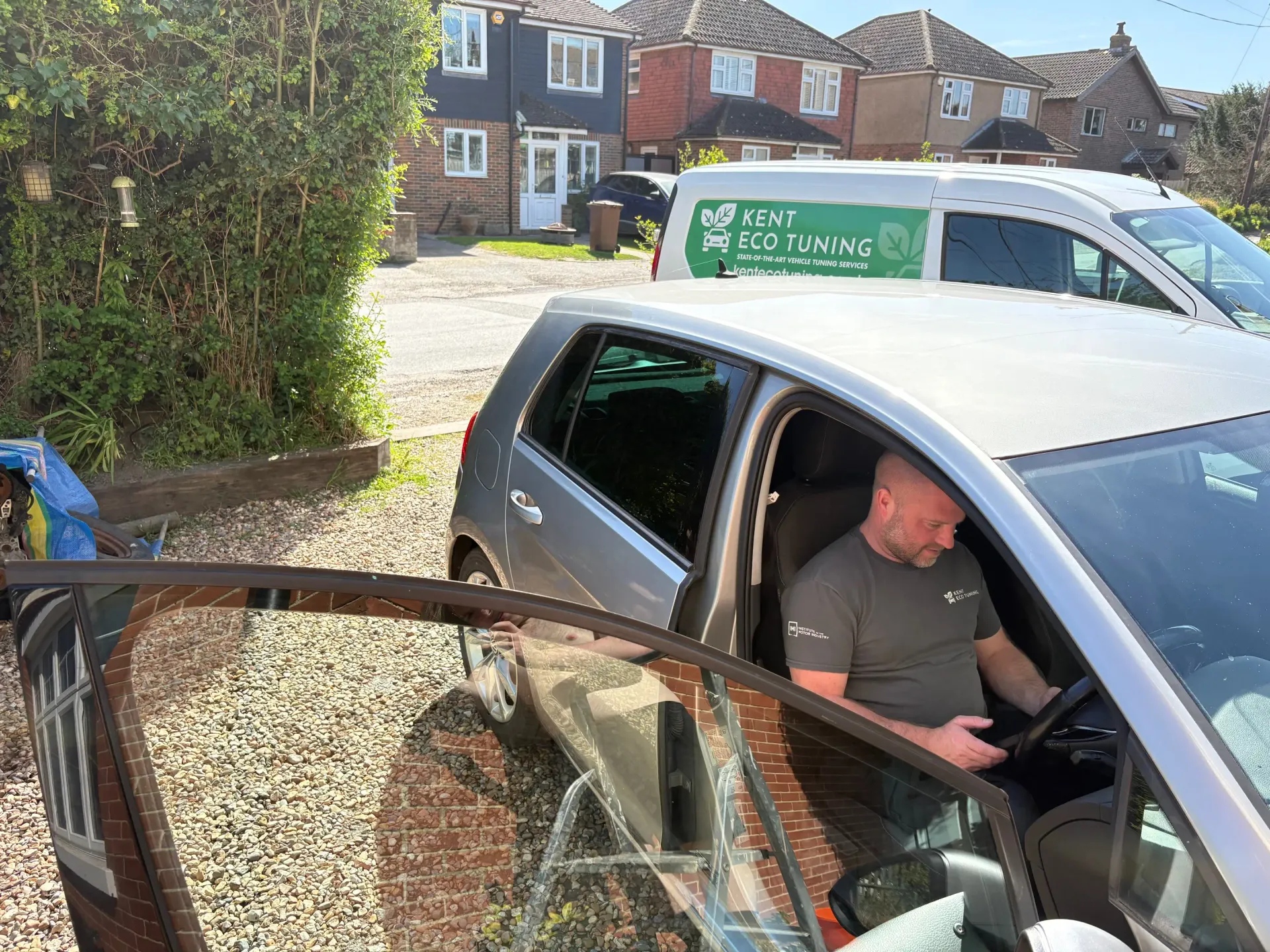
Once that is settled the day itself is straightforward. The car is worked on where it is parked. Nothing is collected, nothing is dropped off, and there is no premises to visit, because this is a mobile service.
The original software is read and archived. The new calibration is written and the car is driven again with the laptop connected, so the second set of readings can be compared against the first.
An existing map is worth mentioning when you book. If the car came to you with a file already on it, or with a tuning box under the bonnet, we identify it first. Building on somebody else's unknown work is a bad idea, and starting from a clean base costs less in the long run.
06
Getting a straight answer
Call 07946 854971 with the registration and we will say what is realistic for your car rather than what you might hope to hear. The contact form works just as well if you are reading this in the evening, and the rest of the range sits at Mitsubishi remapping.
07
ASX tuning questions
08
Can you tune the 1.6 petrol ASX?
It can be done, but the return is modest because the engine has no turbocharger. We will tell you honestly whether it is worth your money for your car.
09
Will a remap affect my insurance?
Any change to the engine software is a modification and should be declared. Most owners find the increase small, but the policy must be accurate.
10
How do I know which diesel my ASX has?
There were three over the car's life, so the registration settles it, along with the gearbox. Send it through and we will confirm the exact version before booking.
11
Do you need the car for a whole day?
Usually no. Most ASX work is finished in a single visit, and the timing depends on whether the car needs extra attention underneath.
12
Related models
Owners often compare this with Mitsubishi Colt, Mitsubishi Eclipse Cross and Mitsubishi Outlander, and each has its own page covering the engines and what the calibration changes.