
01
A car worth keeping, and what that means for tuning
An older car is not a worse candidate for a tune, but it is a different one. Years of use leave their mark on bushes, mounts, hoses and sensors, and a calibration that asks more of an engine will find any weakness already there. On a car somebody loves, that is the last thing anybody wants.
So the inspection is weighted towards the parts that age. Soft boost hoses, a leaking intercooler, a tired diverter valve, a failing coil pack: all are common on cars of this age and all blunt the result. Findings are reported with cost in mind, because the owner is paying for it themselves and wants to plan.
02
The petrol engines
Saab built its reputation on turbocharged petrol engines, and a large share of 9-3 and 9-5 cars on the road carry one, which is much of why they still feel quick today. A turbocharged unit responds to careful calibration in a way a non turbo engine cannot match, and there is real headroom through the middle of the rev range.
Even so, the result is not a transformation and should not be sold as one. What owners describe is a car that pulls more cleanly from low speed, holds a gear on a slip road, and feels less strained when asked to overtake. The delivery becomes more even, and the turbo comes in with less of a pause. That is a modest, useful improvement on a car that is already pleasant to drive.
The naturally aspirated petrols in the range are a different matter. There the headroom is small and the honest answer matches any non turbo engine: the car can be made slightly more pleasant to drive and nothing beyond that. Owners of those cars are told so plainly rather than sold an expectation.
03
The 1.9 diesel, and the checks that come first
The 1.9 diesel is the engine that needs the most care in this conversation. It was fitted across a long production run, the emissions equipment on later cars is now well into its working life, and the two faults that matter most are a particulate filter that has loaded up and an EGR valve that has sooted shut.
Both are assessed before any calibration is written. A filter at the end of its life is a mechanical problem and no file fixes it, and tuning around a blocked filter simply shortens the time before the car stops regenerating properly. The same is true of a sooty EGR valve: the calibration can improve how the engine runs, but it cannot clean a part that is already clogged. Both checks are described on our filter work page and the recirculation page.
Where both are healthy the diesel responds well. Mid range improves, less throttle holds speed, and the economy case is real for a steady commute. It is the strongest argument for a tune on this car, and it comes with the caveat that any saving is down to driving style.
04
Parts, specialists and the practical side of an older car
The owners who get most out of these cars have a specialist they trust and a parts supply they understand. A tune is a small part of keeping an older car going, and it should not be the thing that exposes a fault with no answer to it.
Where a car needs a part replacing before tuning, the sensible order is to do that first and tune afterwards. Paul will say so. There is no benefit in writing a file for a car that will be back on a ramp a month later, and it is a poor use of the owner's money.
The electrical side matters too. A scan often turns up stored codes that have sat there quietly for years, and knowing about them is useful whether or not anything is done.
05
What the diagnostic work finds
The scan is dealer level and covers every control unit on the car. Live data is read under load, where a tired airflow meter or lazy boost control shows itself, and the car is road tested so behaviour can be compared before and after.
On a car of this age the diagnostics are as valuable as the calibration. Owners regularly discover something they did not know about, and while that can be unwelcome news, it is better news before the file than after it. The diagnostics page explains the process, and the core remapping page covers how the calibration itself is written.
06
The method depends on the car
Not every Saab is read through the diagnostic port. Some earlier cars need the control unit worked on directly, and the method is confirmed from the vehicle beforehand so the right equipment and time are brought along.
That detail matters on a car this age, and it is a reason not to promise a schedule on the phone before the car has been identified.
07
Booking a visit for a daily driver
08
Is it worth tuning an older Saab?
If the car is sound and the owner is keeping it, a careful tune makes daily driving more pleasant and, on the diesel, can reduce what it costs to run. If the car needs work, that work comes first.
09
Will a tune fix my DPF or EGR problems?
No, and it is important to be clear about that. A loaded filter needs attention as a mechanical matter, and a sooty EGR valve needs cleaning or replacing. A calibration does not clean either of them, and it will not clear a warning light caused by one.
10
Can every 9-3 and 9-5 be tuned?
Coverage is confirmed from the registration before a booking, because the range ran for a long time across several engine and management combinations. Some cars are straightforward and some need the unit removed, which is established beforehand.
11
Do you travel to the car?
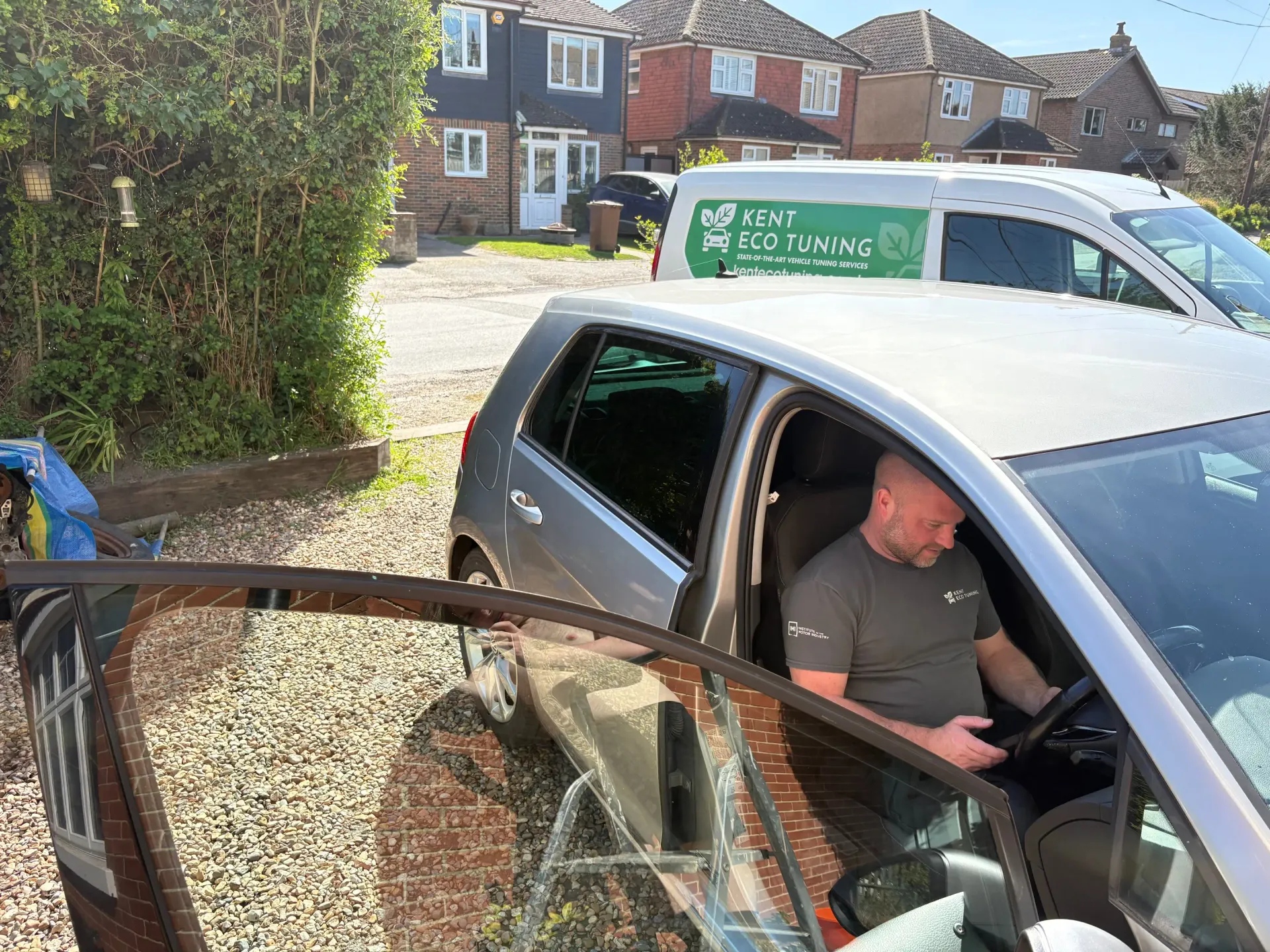
Yes, across Medway, Kent and into Essex within normal reach. The car stays at the owner's address for the whole visit, and nothing is taken away. For a 9-3 or a 9-5, the number is 07946 854971, and the contact form works just as well. Recent work and the engine size help.