
01
Why a GLC responds so well
Most GLCs are bought for practical reasons. They carry people, dogs, bikes, trailers and the sort of loads that a family accumulates without ever planning to. The engine is asked to do that work at low speed and in traffic, which is not where a standard factory file is at its best.
The 220d and 250d are the volume cars, and both use four cylinder diesels. The 300 sits above them in the range, and the AMG 43 sits at the top with a very different character.
On the diesels, what changes is how the car pulls from low down and holds a gear on a hill. A GLC that used to drop a cog on the approach to a roundabout with a trailer on the back can be given the torque to stay in the gear it was in.
On the AMG 43, the change is about response and smoothness rather than load carrying. Different cars, different reasons, and the same starting point of a dealer-level diagnostic health check.
02
Engines and the things worth knowing
The diesels in this range are coded OM651 and OM654, and both respond strongly to a calibration written for real world economy and for towing. They are not the same engine, and the file is not the same file.
The 220d and 250d are the same family in different states of tune, which means one has more headroom than the other. The 300 wants its own approach, and it gets one.
The AMG 43 uses a six cylinder, and it belongs in a different conversation. Anything with AMG badging on it may already have been mapped or fitted with a tuning box, so the history of the car is established before anything is written.
Gearbox options varied across the range and across the years, so what is fitted to your car is confirmed from the registration rather than taken from a specification table.
03
Before the calibration, every time
On a diesel, the emissions hardware is the first thing to assess. A particulate filter that is already loaded with soot, or a recirculation system that is already clogged, needs to be identified before a file goes in.
That is not because tuning causes those problems. It is because a loaded filter and a sooty valve are tired components, and asking them to work alongside a new calibration without mentioning it would be poor practice. Sometimes the right answer is to deal with the filter first and tune afterwards.
This is where honesty matters more than a sale. A calibration is not a fix for a blocked filter or a clogged valve, and nobody here will offer one as if it were. What can be done about the filter sits under DPF software solutions, with the recirculation side under EGR software solutions. A physical blockage means a repair rather than a rewrite.
Beyond that, the check covers stored codes from every module, a road run with live data, charge pipe and intercooler condition, and the fluids along with the service history.
04
What the appointment involves
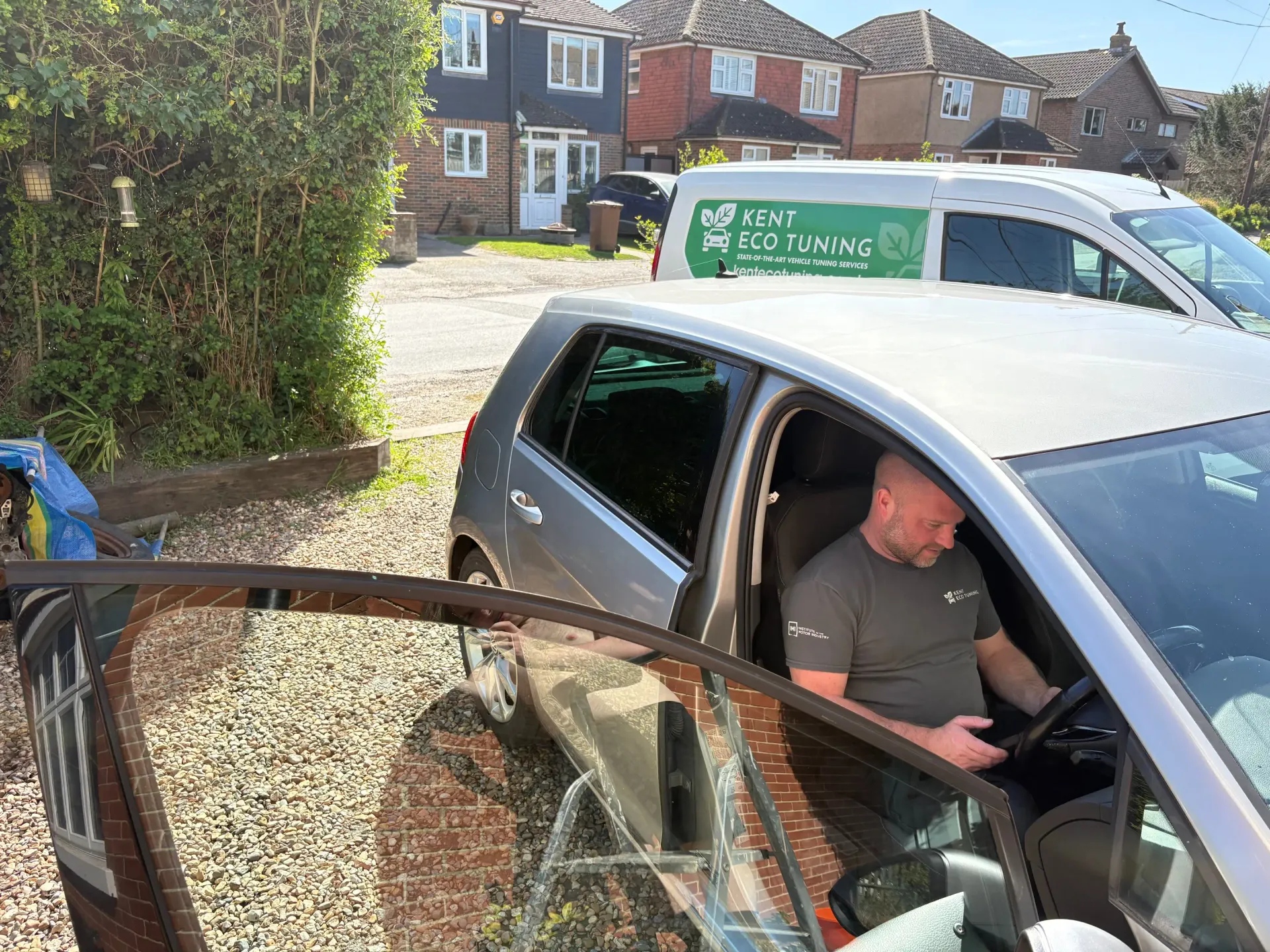
The car stays where it is parked and the work comes to it, whether that is a driveway in Rochester, a yard near Sevenoaks or a farm track out towards the Essex border.
First, the conversation. What the car carries, whether it tows, how much of the week is motorway and how much is short trips. On a GLC, those answers matter a great deal because the same car can be a long distance cruiser or a local runabout.
The factory file is copied and stored first. What goes in next depends on the answers given, whether that means a towing file with torque low down or an economy file for a steady commute.
A second run follows with the same channels recorded, and the pair gets compared. If something is out of step, that gets investigated rather than noted and forgotten.
05
Which direction to take
Economy is the natural request on a diesel GLC, and it is written for the way the car is used rather than for a test cycle. Better economy on a steady run, and a car that is less laboured when it is loaded.
Towing torque is the other obvious choice, and for anyone who hitches a caravan or a plant trailer it is the more useful of the two. The torque arrives earlier and holds, which is what makes a heavy load feel manageable.
Power is available too, and on the AMG 43 it is the usual request. What separates them is set out under power versus economy.
Anyone wanting sharper gear changes has separate gearbox tuning work to consider, since it is a different job.
06
Should you do it
A healthy GLC with full history is a straightforward job, and the change shows in how the car feels to live with. A car with a loaded filter, a boost leak or a mystery map needs those addressed first.
The check exists to find exactly that, and findings are explained in plain language with the choice left to the owner. No work is done on a car that is not sound.
Insurance should be informed of any modification, and this applies to every car regardless of how mild the file is.
07
Getting the car booked in
Call 07946 854971 and have the registration ready, or drop the details into the contact form. Tell us what the car carries and where it goes each week, and the advice follows from that. Everything else in the range sits under Mercedes remapping Kent, and the town list is at areas covered.
08
GLC tuning questions
09
Is the 220d worth tuning if I tow?
It is one of the better reasons to have it done. A towing file gives the car what it needs to hold a gear under load rather than hunting for one.
10
Can a diesel with a loaded filter be tuned?
It can be tuned once the filter is dealt with. Software is not a repair for a blocked filter and it will not be sold as one here.
11
What if my car already has a map?
We read what is there and assess it first. An unknown file is a reason to establish a known base rather than to write over the top of it.
12
Does the AMG 43 need a different approach?
It does. It is a six cylinder with its own character, and any AMG car is checked for a previous map or a tuning box before work starts.
13
Related models
Owners often compare this with Mercedes-Benz A35, Mercedes-Benz A45 and Mercedes-AMG GT, and each has its own page covering the engines and what the calibration changes.