
01
The Science of Precision Calibration
A modern Porsche is managed by an engine control unit that governs fuel delivery, boost, ignition timing, camshaft timing and the torque limits it shares with the transmission. The factory calibration has far less margin for compromise than a volume manufacturer's, because the buyer expects the engine to perform in every market and climate without excuses. The headroom is real but narrower, and the calibration has to be written with more care rather than more aggression.
This is where the usual tuning logic stops being useful. On a hot hatch, a file that adds a bit too much boost is corrected by the knock sensor and the driver never knows. On a Porsche, the same file is a heat problem in a turbocharger that costs a great deal to replace. A file built for the engine code in front of Paul, checked against live data under load and against the condition of the hardware, is the only responsible version of this work.
02
Live Data Before Any File Is Written
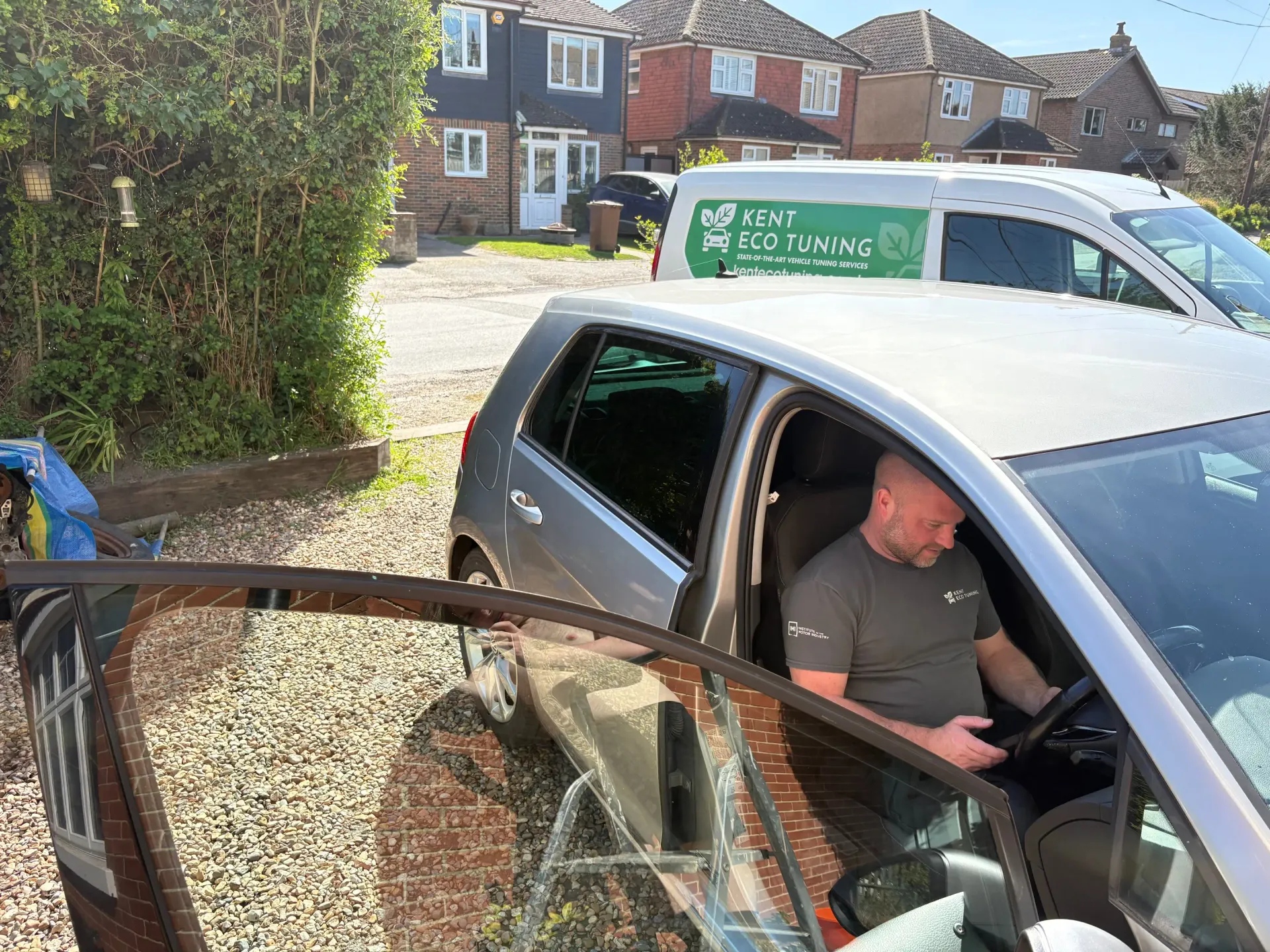
The health check is only half of the pre-work: live data shows how the engine behaves under load, and that evidence shapes the calibration more than the fault-code list alone.
03
Model Coverage
The 911 is the centre of the range. The 991 generation's later cars moved the Carrera onto a turbocharged flat six, and the 992 continued that. The Turbo and Turbo S sit above the Carrera with their own engine hardware, larger turbochargers and different cooling, and they are calibrated as their own cars rather than as a trim of the Carrera. The GT models are a separate conversation, and Paul will be candid about whether one is a sensible candidate at all.
The 718 Cayman and Boxster use a turbocharged flat four in the standard cars, with a flat six in the GT4 and Spyder and in the later GTS. They are mid-engined, light and very well balanced, so the calibration brief is about throttle precision and mid-range flexibility rather than outright output.
The Macan and Cayenne cover a wide spread: turbocharged V6 petrols across both, a V8 in the higher Cayenne models and, in earlier cars, a V6 diesel. The later Macan moved to a smaller turbocharged four-cylinder in the entry models. Each is heavy, with a lot of drivetrain behind it, so the calibration is written around the gearbox and the cooling as much as the engine. Porsche owners comparing the marque against other prestige badges often ask about the Lamborghini as well, and that is handled the same way: coverage confirmed from the registration before any commitment.
Several of the models in that range have their own page covering the engines and what the calibration does for each: Porsche Cayenne and Porsche Macan.
The model pages are now available for the 911, Cayman, Boxster and Panamera, each covering its own engine range and calibration brief.
The new model pages are live for the 911, Cayman and Boxster.
04
High Power & Ultimate Performance Tuning
From the driver's seat, a well-written calibration on a Porsche shows itself in precision rather than drama. The throttle responds to small inputs more directly, the transition as boost arrives is cleaner, and the mid-range holds its strength instead of tapering off. On a 911 Carrera that makes an already capable car feel more connected on a Kent B-road. On a Macan or Cayenne it makes a heavy vehicle feel less strained in the situations owners notice most, which are a loaded motorway cruise and an overtake on an A-road.
The Turbo and Turbo S deserve a word of their own. These are already at a level where more output is not the interesting question, and the sensible work is about delivery: making the power arrive smoothly, keeping the response linear and staying well inside the thermal limits the cooling system was designed around. A calibration that pushes a Turbo hard on a hot day costs the owner a turbocharger.
Whatever the model, boost, fuelling, ignition, camshaft timing and the torque model move together and stay inside the limits the engine and its cooling system were built around. On the dual-clutch cars the gearbox torque limits are part of the brief.
05
Economy You Can Measure
The economy brief focuses on how you actually use the vehicle: the routes, the load and the driving style all shape the result, which is why expectations are set before the work rather than promised after it.
06
Maximum Efficiency & Economy Remapping
Economy is a secondary consideration on a Porsche. What it means here is a calmer, less strained cruise on a long run: a car that sits at motorway speed with less throttle applied, a gearbox that holds a higher gear instead of shuffling, and an engine working in a more efficient part of its range. The 911, the Cayman, the Boxster and the Panamera each have their own page covering the engines and what the calibration changes.
There is no useful figure to quote for a Porsche, and Paul will not invent one. He will tell you whether an economy-leaning calibration is worth the work on your car, which depends on the engine, the gearbox and the journeys it does. On a Macan used for a daily commute there is a reasonable case. On a 911 that comes out at weekends, there is not.
07
Specialist Software Solutions: DPF, AdBlue and EGR
The diesel Macan and Cayenne are where this section matters, and there are still plenty about. Those engines carry a DPF, an EGR system and AdBlue. None of that equipment is removed, bypassed or written out of the software, and no emissions function is disabled by a calibration. Defeat work on a road vehicle is not something we do, and removing or disabling emissions equipment can fail an MOT.
The petrol cars run catalytic converters and, on later models, gasoline particulate filters. None of that is touched either. Where a warning appears, the work is diagnosis: soot loading, differential pressure, regeneration history, AdBlue quality and dosing, EGR flow against commanded position. A calibration written around a healthy regeneration strategy keeps a working filter doing its job. A filter that is genuinely blocked needs a repair, not software. Read more on our DPF solutions page.
08
Smoother Shifts, Protected Clutches
A gearbox calibration pairs naturally with an engine remap: the engine raises available torque and the transmission calibration manages how it is delivered and protected.
09
Transmission Tuning: PDK and the Manuals
Most modern Porsches are PDK, the dual-clutch gearbox Porsche has developed further than almost anyone, and the rest are manual. The PDK is the more complex conversation, because the engine and gearbox communicate through torque limits, and a calibration that ignores them is one the gearbox will clamp anyway. Where the hardware is healthy, the transmission can be calibrated alongside the engine so its shift strategy suits the new delivery. The manual cars are simpler in one sense and less forgiving in another, because the clutch takes everything the engine gives it. On a car with a lot of miles, the clutch is the first thing to assess.
10
Why Choose Kent Eco Tuning for Your Porsche?
The reason to have this work done here is not a claim about being the biggest specialist in the country. It is that the advice is independent, the tuner is IMI-certified, the business is an approved Quantum Tuning dealer and the service is fully insured and mobile, coming to your home or workplace across Kent and Essex. In practice that means a conversation before a sale.
11
Popular models
The Porsche 911, Cayman, Boxster and Panamera each have their own model page: 911, Cayman, Boxster and Panamera. For the rest of the work we do, see the ECU remapping service and the diagnostics page.
12
Porsche Remap FAQs
13
Is a Porsche a sensible car to remap?
It can be, on the right car and with the right brief. The engines have real headroom, but the margins are narrower than on a volume car, so condition and calibration quality matter more. Paul will assess yours and give you a straight answer, including when that answer is no.
14
Which Porsche engine do I have?
The 911 uses turbocharged flat sixes across the 991 and 992 generations, the 718 Cayman and Boxster a turbocharged flat four in the standard cars, and the Macan and Cayenne a mix of turbocharged V6 and V8 petrols with a V6 diesel in earlier cars. Send Paul your registration and he will confirm the exact engine and gearbox.
15
Can you remove the DPF from my diesel Macan or Cayenne?
No. Defeat work on a road vehicle is not something we do, and removing or disabling emissions equipment can fail an MOT. We diagnose why a system is warning and tell you honestly whether the cause is usage, a faulty component or a filter that needs replacing.
16
Book Your Porsche Remap
As an independent specialist we are not affiliated with, endorsed by or connected to Porsche. Call Kent Eco Tuning on 07946 854971 with your registration and engine code, or send a message through our contact page. What is available for your car is confirmed against tool coverage before the appointment is booked, and the mobile service comes to you across Medway and Kent. Check your postcode on the areas we cover, and see the diagnostics and health check page for what every appointment opens with. The Porsche Macan is our first Porsche model page and covers the 2.0, 3.0 and diesel in detail. The Porsche Cayenne has its own page.