
01
The EA888 is why these are tuneable
Almost every Cupra you will find uses the Volkswagen Group's EA888 turbocharged four cylinder, in 2.0-litre form. It is the engine that powered a very large part of the group's performance range for more than a decade.
It is one of the most widely tuned engines in the world, and that is genuinely useful. It means the limits are well understood, the failure points are documented, and a careful calibration for it is not an experiment.
The earlier 1P generation, from 2007 to 2012, used the older EA113 engine in its hotter forms. That is a different engine family with different behaviour and a different approach. The 5F generation, from 2013 to 2020, moved across to EA888. From 2020 the fast Leon moved to the separate Cupra brand, and those cars use later versions of the same engine family. We treat them the same way, so it makes no difference to us which badge is on the boot.
We read the registration rather than trust the badge, because Cupras get badged, debadged and rebadged by owners with strong opinions.
02
What stage of life the car is in matters more than the year
A Cupra at eight years old with a hundred and twenty thousand miles is not the same proposition as one with forty thousand. Not because the engine wears out, but because everything around it does.
Coolant hoses, the water pump and thermostat housing, the diverter valve, the PCV system, the intake carbon build up on the earlier direct injection engines: these all become relevant around the same mileage. A calibration on a car with a weeping water pump is a breakdown waiting for a warm day.
So before we talk about what we can do, we look at what the car needs. If the honest answer is that a service, a set of plugs and a new diverter valve will give you more than a file, we will say it.
03
Torque limits by gearbox
This is the section that matters most on a Cupra, because Volkswagen Group fitted several different gearboxes across the range and they do not all have the same appetite.
04
The six speed manual
Fine for a standard car, and it becomes the limiting component once low end torque climbs. The clutch is the first thing to complain, usually as a slip in fourth or fifth under load rather than anything dramatic.
05
The seven speed wet clutch DSG
The DQ381 family, fitted to most of the later performance cars. It is a strong unit and it handles torque well. It also has its own control unit with its own torque ceiling, and exceeding it is how you get a gearbox that drops into protection at the worst moment.
06
The earlier six speed wet clutch DSG
Used on some of the earlier cars. Also capable, but the calibration of its control unit is older and less forgiving of a torque spike at low speed.
Whatever you have, the principle is the same. We build torque progressively rather than in one hit. That protects the clutch, keeps the gearbox out of protection, and gives you a car that behaves the same in the wet as it does in the dry, which on Kent's roads is most of the year.
07
Front wheel drive against four
The Cupra was sold in both front and four wheel drive forms, and the difference is not just traction.
A front drive car with a lot of torque will spin the wheels and fight the steering, so torque delivery has to be managed carefully to keep it usable. A four drive car puts it down, which flatters the car and also means the driveline carries the load instead.
Neither approach is better. They need different priorities, and we set the file accordingly rather than using one for both.
08
The diagnostics session, in detail
Before a single line is written, the car goes on dealer level diagnostics.
We read stored and pending codes from every module. We watch the live readings under load: boost against what was requested, trims, intake temperature, timing and knock retard. We check the adaptation values in the gearbox control unit to see how the clutch packs are wearing.
Then we look at it. Oil condition and service history. Coolant level and colour. The state of the intake pipework and the diverter valve. Plugs, if the history is unclear. Brakes and tyres, because a Cupra that cannot stop is not a fast car.
A fault means a repair first, and the calibration waits until it is done. The diagnostic session is listed in full on its own page.
09
What about a car with hardware already fitted?
Plenty of Cupras have an intake, an exhaust or an intercooler on them. That is fine, and often a good sign that the owner cares.
What is not fine is running those parts on a standard file or, worse, on a cheap generic file that was never adjusted. We read what is in the ECU first. If it is a decent base, we work from it. If it is a copied file from another car, we will say so and recommend a clean standard starting point.
10
Getting to you
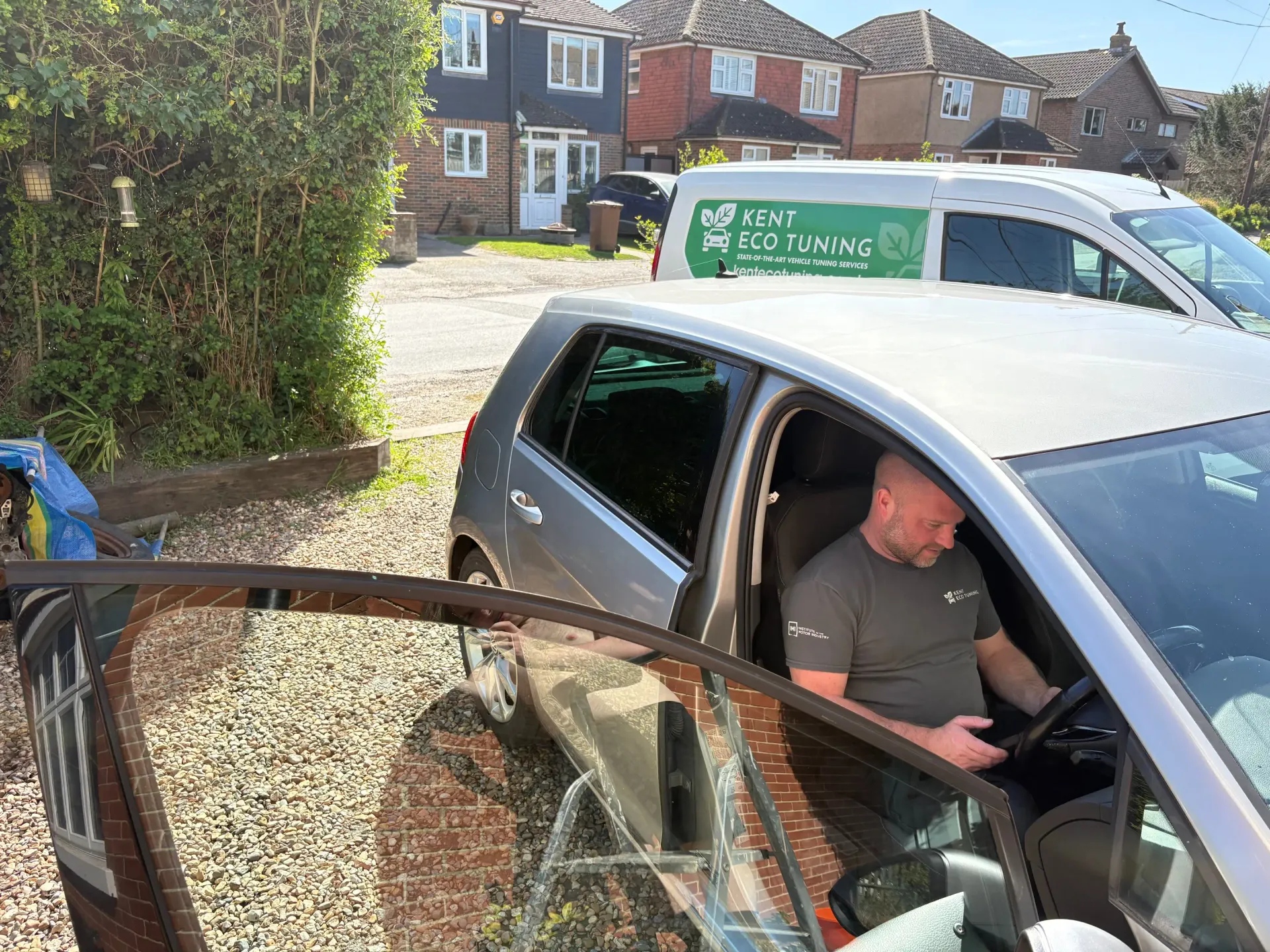
The car never moves, because the service is fully insured and mobile and the gear arrives with us, wherever in Medway, Kent or Essex you happen to be. A driveway in Rochester, a unit in Maidstone, a car park near Sevenoaks. We need a level surface and space around the car, which is usually available.
There is no workshop visit and no collection. Most bookings finish inside half a day, from the first checks to the road test at the end.
11
Let us look at the car first
Give us a bell on 07946 854971, with the year and whether it drives two wheels or four if you know. We will confirm the engine and gearbox before saying anything about what is possible. Other SEAT models are listed on the SEAT remapping page, and the Maidstone page shows how the mobile service works in that part of the county.
12
Cupra questions
13
Which engine do I have?
Send the registration and we will tell you. It is genuinely not possible to be certain from the badge and the year alone.
14
Can you tune a Cupra with a DSG?
Yes. We work within the gearbox control unit's torque limits rather than pushing against them, which is why the car stays reliable.
15
Will it void my warranty?
If the car is still inside its SEAT warranty, ask them for their position in writing before anything is written.
16
Do you do the DSG service as well?
We diagnose gearbox faults and we can advise on servicing, but the calibration work is our focus. Our gearbox and drivetrain section explains that side of the business.
17
Related models
Owners often compare this with SEAT Ateca, SEAT Leon FR and SEAT Ibiza, and each has its own page covering the engines and what the calibration changes.